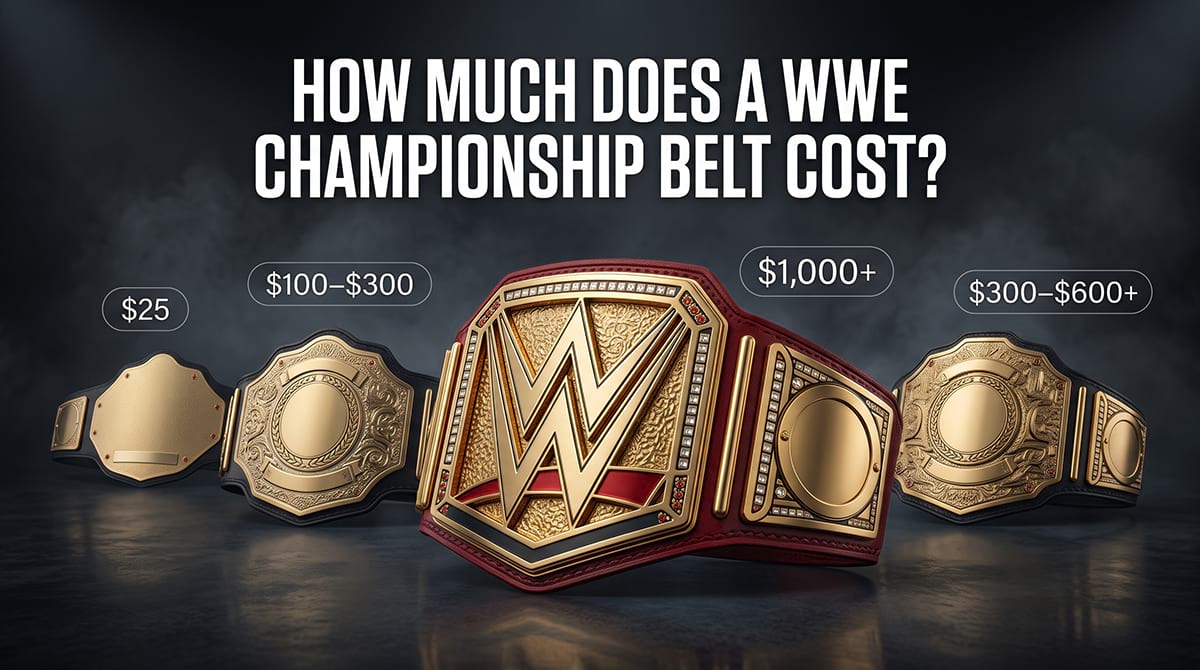
A WWE Championship belt looks like it costs a fortune, and depending on which one you’re asking about, it might. Type “WWE championship belt cost” into Google and you’ll get two very different answers: a $600 replica from WWE Shop, or a vague guess that the real thing is worth “thousands.” Neither answer tells you what you actually need to know before you spend money.
The truth splits into three distinct price tiers: toy belts, officially licensed replicas, and the hand-crafted originals that champions carry on television. Each one is built differently, priced differently, and made for a different kind of buyer. This guide breaks down real numbers for all three, plus the specific factors that push a belt’s price up or down, so you know exactly what you’re paying for.
Quick Answer
WWE replica belt prices run from $24.99 for a toy belt to $599.99 for an official adult-size replica at WWE Shop. Authentic belts used on WWE television cost roughly $10,000 or more to hand-build, according to longtime WWE belt maker Dave Millican. Novelty titles like the Million Dollar Championship and vintage originals like the Winged Eagle belt can be worth far more to collectors.
WWE Championship Belt Prices at a Glance
How Much Do Official WWE Replica Belts Cost?
WWE Shop is the benchmark for “official” pricing, and the range is wider than most fans expect. The flagship adult replicas — including the Undisputed WWE Championship, the WWE World Heavyweight Championship, the WWE Championship Spinner belt, and the WWE United States Championship — retail for $599.99 each. That price gets you a full-size belt built to match the exact plate design worn on television.
A second tier of belts, including the Women’s World Championship, Women’s Championship, Intercontinental Championship, Women’s Intercontinental Championship, Attitude Era Intercontinental Championship, and both tag team titles, runs $524.99.
Below that sits the “commemorative” line, priced around $369.99. These use simplified detailing and lighter materials than the flagship replica tier, which is how WWE keeps a lower price point without cutting the license entirely. Toy belts, aimed at kids and casual buyers, sit at $24.99–$34.99, and an acrylic display stand for showing off any belt runs $119.99.
If you’re comparing wwe belt price options and want the closest thing to the belt you see on RAW or SmackDown, the $524.99–$599.99 tier is what you’re after. For a deeper breakdown read our complete replica WWE championship belt buying guide.
What Actually Drives Replica Belt Pricing
Two belts can look nearly identical in a product photo and still differ by $300. Here’s what separates a $100 belt from a $600 one:
- Plate thickness. Budget belts use 1.5mm zinc alloy plates that can warp or bend during shipping or wear. Premium replicas use 2mm to 8mm plates that hold their shape and carry real weight — closer to 5–6 lbs, similar to what wrestlers actually wear.
- Plating quality. Most replicas use a gold-tone finish over base metal, not real gold. Higher-end belts apply thicker, more durable plating that resists tarnishing longer.
- Leather strap. Entry-level belts use synthetic PU leather. Mid-range and premium belts move to genuine cowhide, which lasts longer and ages better.
- Detail depth. Officially licensed belts use raised, 3D-engraved plates that match the TV design exactly. Unlicensed versions often flatten or simplify the artwork to avoid copying it too closely.
- Licensing fees. A meaningful chunk of the WWE Shop price isn’t materials — it’s the licensing cost built into every officially branded product. That’s the single biggest reason unlicensed replicas can look similar but cost half as much.
Budget and Third-Party Replica Belts ($50–$300)
Not every fan wants to spend $600, and third-party belt makers fill that gap. Prices generally break into three bands:
- $100–$150 — basic replicas. Synthetic leather, lightweight zinc plates, simplified engraving. Fine for a costume or a one-time photo, not built for daily wear.
- $170–$200 — mid-range replicas. Thicker plating (typically 2mm–4mm) and more accurate detailing. This is the sweet spot for most fans who want something that looks right without WWE Shop pricing.
- $200–$300 — premium unlicensed replicas. Close to official quality in weight and finish, sometimes using real leather and multi-layer plating, but without WWE’s license.
The trade-off with unlicensed belts is consistency. Since they aren’t produced under WWE’s quality control, build quality can vary between sellers and even between batches from the same seller. Check seller reviews, ask about plate thickness in millimeters before buying, and confirm return policies — especially on overseas listings where return shipping can cost more than the belt.
Clash Champion Belts offers replica championship belts from around $180 to $300+, with options for different plate materials, thicknesses, and small customizations such as adding your name. Looking for a WWE replica? Explore our WWE Championship Belts collection to find a design that fits your budget and style.
How Much Does a Real WWE Championship Belt Cost?
This is the number most people are actually curious about, and it’s rarely answered accurately. The belts wrestlers carry on WWE television aren’t sold anywhere — they’re commissioned, hand-built, and owned by WWE.
Belt maker Dave Millican has personally crafted most of WWE’s television championship belts for more than three decades, from the WWE Championship to the World Heavyweight Championship to the Intercontinental title. In interviews, Millican has explained that a comparably detailed custom title belt — he specifically discussed the AEW World Championship, built to the same craftsmanship standard as WWE’s belts — runs into five figures, commonly $10,000 or more, once you account for layered gold plating, hand-set stones, and custom artwork. That figure lines up with what serious custom belt makers charge for premium, professional-grade titles today.
There’s another detail most articles miss: each WWE champion typically receives at least two belts — one that travels with them to live events, and a separate belt reserved for televised matches and pay-per-views. That effectively doubles the real production cost behind every reign.
What’s Inside an Authentic Championship Belt
- A brass or zinc base plate, hand-cut and shaped before plating
- Multiple layers of gold plating, applied by hand rather than machine-dipped
- Hand-set gemstones or cubic zirconia, individually placed rather than glued in sheets
- Full-grain leather strap, hand-stitched to the plates
- Custom hand-engraving unique to each title design
None of this is available at retail. If you see a listing claiming to sell an “authentic” TV-used WWE belt, treat it as a red flag — WWE does not sell its television or travel belts to the public.
How Much Are Famous WWE Belts Worth?
Some WWE titles carry a value story beyond their production cost, driven by history rather than materials alone.
The Million Dollar Championship is a useful case study in what “value” actually means for a wrestling belt. Ted DiBiase has explained that despite its name, the belt was never insured or valued at $1,000,000. Most of the roughly 700 stones on its face are cubic zirconia rather than diamonds — DiBiase has said each one cost around $50 when the belt was made — with three genuine diamonds hidden on the back, placed there specifically so he could honestly say “yes” if a fan asked whether any of the stones were real.
You’ll find blog posts online claiming specific original belts, like the Winged Eagle or Spinner title, sold at auction for anywhere from $85,000 to $400,000. Most of those figures trace back to uncredited blog claims rather than a documented public sale, so treat them as collector folklore, not confirmed pricing. What’s actually verifiable is scarcity: original TV-used belts almost never reach the open market, and when ownership does change hands, the price is set privately between collectors rather than published anywhere.
Myths vs. Facts: WWE Belt Pricing
Final Thoughts
WWE championship belt cost isn’t a single number, and that’s exactly why so many searches for it leave fans more confused. A $600 official replica, a $10,000-plus hand-built television title, and a $40,000 novelty belt like the Million Dollar Championship are all technically “WWE belts,” but they’re not remotely comparable products.
If you want screen-accurate detail without guessing, stick to WWE Shop’s replica tier or a well-reviewed third-party maker who’s transparent about plate thickness and materials. If you want something that’s actually yours — a design built around your name, your league, or your event — a custom championship belt gives you control that no off-the-shelf replica can match. Either way, knowing what drives the price means you’ll never overpay for a belt that doesn’t back it up.